

Is Saving the Earth Profitable?
How we can fund the $6 trillion it will take to prevent the climate from getting much worse

Dear Eater,
I am optimistic about climate change.
There are solutions available here and now. So why aren’t they being implemented as fast as they need to be? The simple answer is: we need funding.
This funding can come from mainstream financial institutions because investment in climate solutions can be profitable.
How much money do we need to solve the climate crisis?
As a PhD Economist with over 25 years of research experience and the Faculty Director at UCSC Institute for Social Transformation, this is an area I spend a lot of time thinking about.
The UN Intergovernmental Panel on Climate Change (IPCC) estimates that climate finance for mitigation and adaptation must increase by 3–6 times current levels by 2030 to limit global warming to 1.5–2 °C — a figure that external analyses of IPCC-consistent pathways put at roughly 6 trillion USD per year, or about $750 per person globally. This may seem manageable in the abstract until you consider that roughly half the world’s population lives on less than $7 USD per day, or roughly $2,500 USD per year.
The responsibility for financing climate mitigation and adaptation should fall on those whose emissions created the climate crisis, and whose wealth reflects it. The wealth that developed countries enjoy is built on a century and a half of producing GHG emissions without having to account for their impact on the planet or pay for the damages they cause and will continue causing for centuries to come. That accumulated wealth is now the most viable source of capital for financing the transition.
The question is, how do we unlock it?
How do we get the $6 trillion we need?
The wealth of individuals and corporations in rich countries is generally deposited with financial institutions that go on to invest or “manage” it. Globally, this wealth, or assets under management (AUM), is expected to reach $200 trillion USD by 2030. If just 3% of global assets under management were invested in climate solutions every year, this would be the $6 trillion USD we need to avoid the worst climate-related damages.
The question then becomes about incentives. What would help global money managers direct their investments to climate solutions?
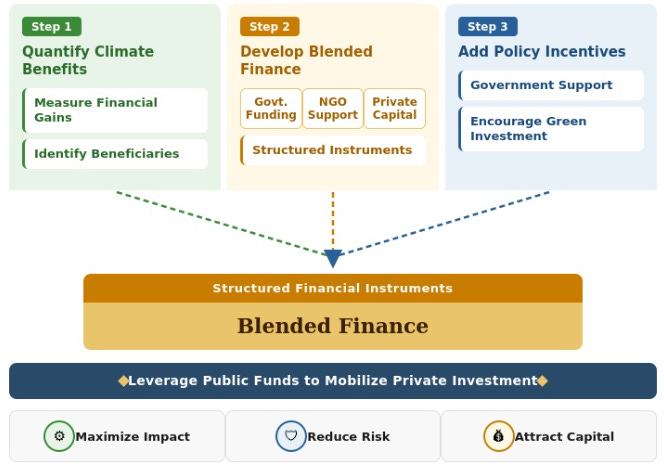
Source: Infographic describes the structure of blended finance created by the author with the help of the Claude (Anthropic) AI engine.
First, we need to quantify the financial benefits of climate solutions (like the Social Cost of Carbon, but in a way that’s asset- or location-specific) and figure out which economic agents get to enjoy these benefits. This means carefully measuring the impacts of each climate solution on all potential stakeholders, including nature, individuals, corporations, and governments.
Project Drawdown has taken an important step in this direction. My recent work on the private benefits of nature-based solutions, including the research paper “Financial Value of Nature: Coastal Housing Markets, Mangroves, and Climate Resilience,” is an example of how one may go about it.
Second, we need to create financial instruments that provide incentive-compatible ways for financial institutions to participate. These will most likely include contributions from governments and NGOs to make investments less risky and more attractive. These instruments are called structured or blended finance. They are the best bang-for-the-buck for nonprofit and government investment because it allows these limited funds to leverage private assets.
This is a relatively new area of finance, and many like-minded finance faculty are starting to introduce this material in their curricula. In fact, there is a faculty consortium on Impact & Sustainable Finance that encompasses many finance faculty across the world.
Third, we need governments’ assistance in creating additional incentives for investments in climate mitigation and adaptation. Some encouraging examples already exist. For instance, the UK government’s Contract for Difference (CfD) program is essentially a blended-finance program where the UK government guarantees a minimum price for electricity generated by low-emission producers. This guarantee de-risks investment in offshore wind installation. Another example is the Norwegian government’s company Enova, which provides grants to jump-start investment in emerging decarbonization technologies and in bridging the gap between research, pilot stages, and commercial deployment.
Aligned incentives to drive financial investment
Over time, markets will more fully account for impacts on people, animals, and the planet. But we don’t have to wait for that future to act. There are many opportunities today where financial returns align with positive outcomes for society and the environment.
Our task is to identify and scale projects or innovations that address climate challenges and create economic value. If we do this well, we’ll harness the full force of global markets to accelerate climate progress.
There is no shortage of capital. The opportunity now is alignment.
Concrete insights for practical progress
If you’re interested in how these ideas translate into real-world action, my TEDx Santa Cruz talk, “Funding Climate Solutions,” offers a concise overview of the mechanisms and opportunities to put this approach into practice.